Negro kleden
Explore records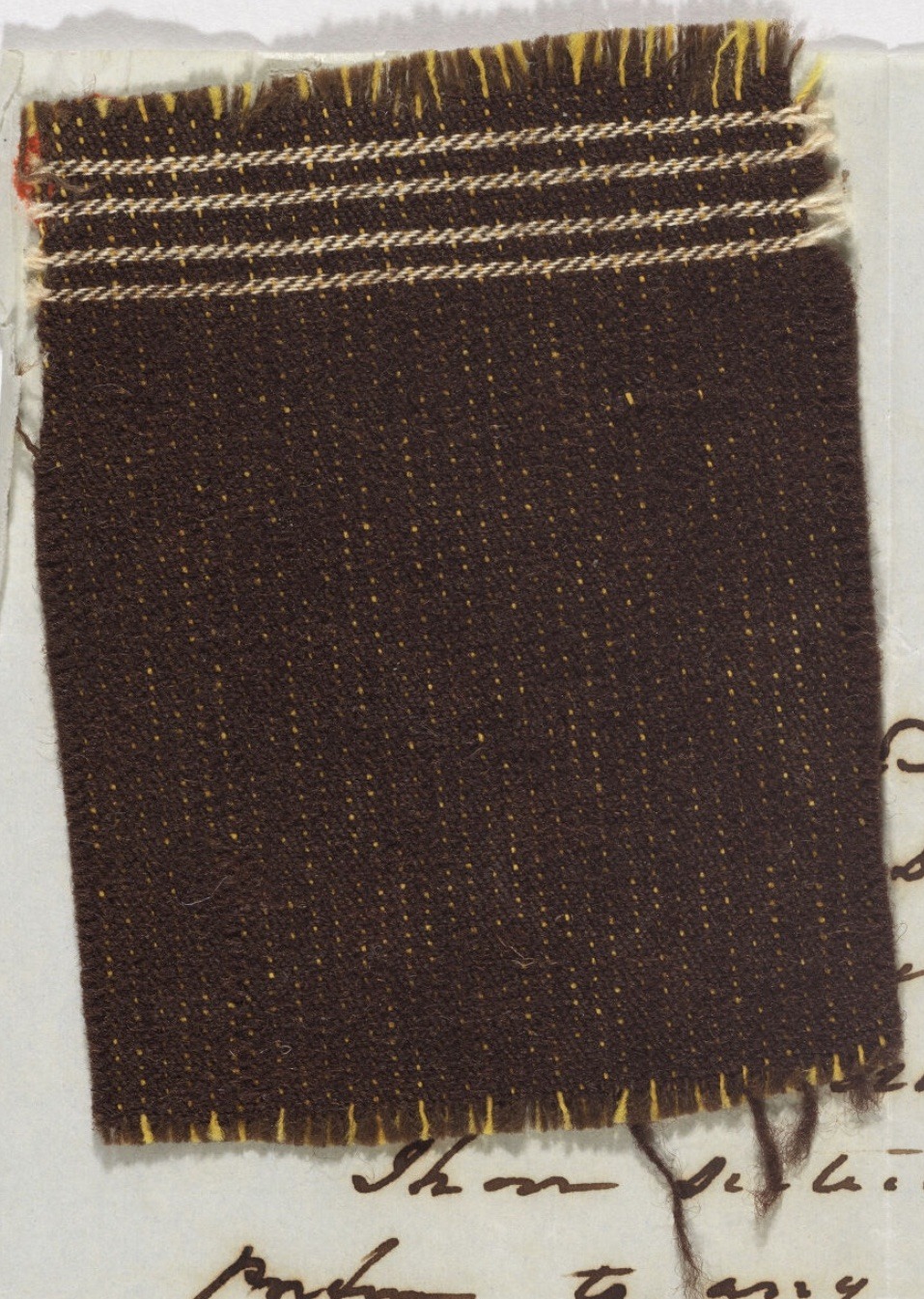
Definition
A durable and coarse cotton or woolen cloth, made in a variety of colors and patterns, possibly a general term for a group of related textiles, primarily associated with the clothing of enslaved people in the Americas.
Related textiles
Context
Sources do not agree on the appearance or fiber of negro kleden , or “negro cloth” in English , with suggestions that it is woolen and/or cotton, in different colors and striped or checkered patterns. Extant swatches likewise challenge categorization, woven in plainweave or twill, in varying colors and plain, checkered, or striped. [1] A recently rediscovered 1783 sample in the Derbyshire Record Office was handwoven and handspun of local English wool and dyed a dark indigo blue in England. The accompanying label calls it both Penistone and negro cloth. [2] Later examples of nineteenth-century negro cloth, featured in Anna Arabindan-Kesson’s study and considered here, look entirely different. [3] Data about the eighteenth-century negro cloth carried on Dutch ships, of which no swatches have yet been found, suggest still further variations.
Arabindan-Kesson’s search for negro cloth turned up three examples, all cotton and machine-woven, from the 1830s–1840s. These show a variety of appearances: solid, checked, and striped; in brown, yellow, blue, and white. They all share a dense weave, presumably durable and perhaps coarse. The example at left is dark and solid in appearance from a distance, but with close examination of its frayed edge, we can see that the warp alternates dark brown and yellow threads, while the weft, woven in a twill structure, is dark brown, mostly concealing the yellow. The white stripes may indicate a pattern or the selvedge. The example at right, also woven in twill, has different colors in stripes: the blue and cream of the warp nearly conceal the white weft. This patterning of stripes recalls another textile, nickanees (although nickanees are consistently plainweave, not twill). With varying appearances, fibers, and weave structure, negro cloth seems to be a general term encompassing several types of durable, coarse textiles, thus explaining the variety of appearances of these samples.
Negro cloth seems, by its naming, to be destined to clothe Black subjects, and is particularly associated with slavery in the Americas. There are a number of excellent recent studies on this topic, by Seth Rockman, Robert DuPlessis, and Jonathan Squares, in addition to Anna Arabindan-Kesson. [4] These studies contextualize the term and examples of the cloth itself in the early United States, where it was entangled with the history and experience of slavery. These scholars argue that while the cloth could come in many colors and patterns, it is largely defined by its durability and coarseness. Enslavers purchased the cloth in order to withstand heavy wear and protect the bodies of enslaved people from the beating sun of the cotton fields of the south, and through cold winters in northern or elevated locations. This was not for the comfort of the enslaved, but to protect the value of the enslaver’s investment. The coarseness of the cloth served to remind the enslaved person wearing it of their status through their discomfort, as well as to remind observers that those wearing it were enslaved. [5] In addition to the three samples she discusses, Arabindan-Kesson cites written descriptions of negro cloth, preserved in American and British textile manufacturing company archives. Many of these are requests from customers (enslavers), asking for heavier- or lighter-weight cloth, presumably depending on their particular climate, again indicating that the qualities of negro cloth varied considerably. Seth Rockman adds that this same cloth in other contexts, say of white industrial laborers in the northern United States, would be called by other names—so the term ‘negro cloth’ is all about context. [6]
Negro cloth was sewn into all different types of garments, including pants, dresses, waistcoats, outerwear, and shirts, although many descriptions of the clothes worn by enslaved people also include light cotton or linen shirts, which would be made from other textiles (see osnaburg/Osnabrück under lijnwaad (linen) ). In this photograph of a group of enslaved people in South Carolina during the American Civil War, the men all wear a shirt of light color, and the three standing men also have matching dark vests. The cloth of the mid-tone pants, jackets, and dresses of the women at left and right seems heavy when compared to the drape of the men’s shirt sleeves and the light-colored dress of the woman holding a child at right, which shifted in the wind during the long exposure of the photograph. Her apron, while heavy enough to remain still, has a sheen that suggests it is a different, finer cloth. The heavier clothing worn by nearly all these figures might be examples of American negro cloth, of similar quality to the plain dark swatch from a few decades earlier.
It is a challenge, however, to see clear connections between nineteenth-century American negro cloth and the negro kleden circulating on Dutch ships in the eighteenth century. Can similar qualities be presumed, or is this an entirely different textile? In the dataset, negro kleden is never described by appearance, so we cannot conjecture as to color or pattern. It is also never described as ‘assorted,’ a modifier which suggests there are variations, and which appears frequently for other textiles. Does Dutch negro cloth have a consistent appearance or quality, unlike American negro cloth? Laarhoven provides a piece-size measurement of 6.3–13.5 x 0.9m. [7] For 1700–1724, a piece of negro cloth was priced at 1.5–1.8 Dutch guilders. For comparison, nickanees , which are a similar size, sold for 2–8 guilders per piece. Guinea cloth , which is 3 or 4 times larger, sold for 20–25 guilders per piece. These price differentials suggest that these cloths had qualities that differentiated them to buyers, and they were not interchangeable, even if scholars sometimes conflate the terms. [8] From 1700–1724, 44,338 pieces of negro cloth circulated on Dutch East India Company ships, in all instances originating from the Coromandel Coast of India or Sri Lanka (perhaps Coromandel cargo shipped via Sri Lankan ports), and destined for the warehouses of Batavia and the Dutch Republic. Only about a third of this negro cloth is also described as “Coromandel” on the cargo lists, but this geographic modifier likely applies to all negro cloth in these Dutch cargoes. With its origin in India, it can be assumed that the dataset’s negro cloth is woven from cotton, even when that descriptor was not preserved, so perhaps it bore more similarity to the nineteenth-century American examples, than to the late eighteenth-century English woolen sample.
Considering that the primary association of the term negro cloth is as clothing for enslaved people in the Americas, it is striking that our data covering 1700–1724 primarily shows the cloth circulating from India to the Dutch Republic. It is possible that the negro kleden in this dataset was recategorized and renamed if it was exported from the Netherlands westward. However, if it remained in circulation in the VOC realm and in the Dutch Republic, where the terminology of race and slavery signified differently, we should be cautious about applying later interpretations to this context. Interestingly, Laarhoven notes that in the early seventeenth century, a small quantity of negro cloth circulated in Indonesia to be made into tapis (a woman’s tubular garment), another textile type moving in Dutch East Indian cargos. [9]
MK (May 2025)
Notes
- [1]
A typical entry is “plains — (or ‘Negro cloth’) generally white, green, or blue cheap woollens, usually woven in Wales or the West Country of England.” Giorgio Riello and Prasannan Parthasarathi, eds. The Spinning World: A Global History of Cotton Textiles, 1200-1850 (Oxford University Press, 2009), 416.
Back to text - [2]
The sample is discussed at length in an episode of the podcast Haptic and Hue, and illustrated in the show notes: https://hapticandhue.com/episode-39-sliver-of-deep-blue-cloth/; and also was the subject of a news article: https://www.theguardian.com/world/2023/apr/02/only-surviving-fragment-of-slave-cloth-found-in-derbyshire-record-office.
Back to text - [3]
Anna Arabindan-Kesson, Black Bodies, White Gold: Art, Cotton, and Commerce in the Atlantic World (Durham: Duke University Press, 2021), 42–57.
Back to text - [4]
We are excitedly anticipating Jonathan Square’s forthcoming Negro Cloth: How Slavery Birthed the Global Fashion Industry , which includes a chapter on Lowell cloth.
Back to text - [5]
DuPlessis also discusses coarseness and discomfort as essential factors of the clothing provided to enslaved subjects: Robert S. DuPlessis, The Material Atlantic: Clothing, Commerce, and Colonization in the Atlantic World, 1650–1800 (Cambridge University Press, 2016), 131–135, especially p. 131 where he describes “cheap, coarse, often uncomfortable fabric.” See also Robert S. DuPlessis, “‘A Few Shreds of Rough Linen’ and ‘a Certain Degree of Elegance’: Enslaved Textile-Makings in Colonial Brazil and the Caribbean,” in In-Between Textiles, 1400–1800: Weaving Subjectivities and Encounters , ed. Beatriz Marín-Aguilera and Stefan Hanß (Amsterdam: Amsterdam University Press), 95–112.
Back to text - [6]
Seth Rockman, A Material History of American Slavery (University of Chicago Press, 2024), 309.
Back to text - [7]
Ruurdje Laarhoven, “The Power of Cloth: The Textile Trade of the Dutch East India Company (VOC) 1600–1780” (PhD diss., Australian National University, Canberra, 1994), appendix A, 24.
Back to text - [8]
The VOC Glossary, in contrast, suggests that negro cloth is interchangeable with guinea cloth, and so named for who it was sold to. This seems incorrect given the price and size differences, and in the American context, at least, it was not sold to Black consumers but rather to enslavers. Instituut voor Nederlandse Geschiedenis, VOC-Glossarium. Verklaringen van termen, verzameld uit de Rijks geschiedkundige publicatiën die betrekking hebben op the Verenigde Oost-Indische Compagnie (The Hague: Institute voor Nederlandse Geschiedenis, 2000), 81. Also available as interactive here: http://resources.huygens.knaw.nl/vocglossarium/zoekvoc
Back to text - [9]
Laarhoven, “The Power of Cloth,” appendix A, 46.
Back to text
Visual evidence
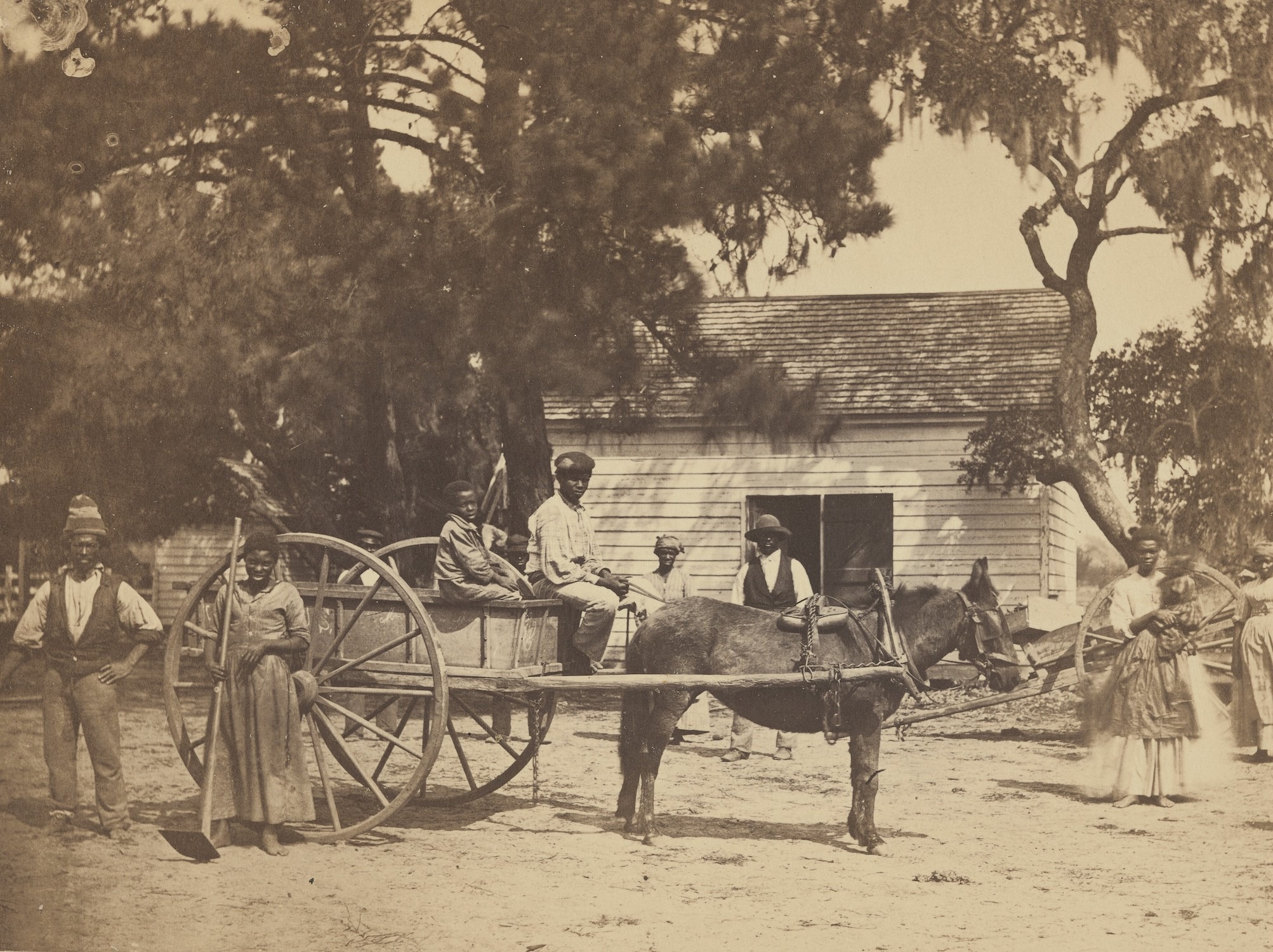
James Hopkin's Plantation, Edisto Island, South Carolina, 1862
Enslaved men, women, and children on a South Carolina plantation, posing with a cart and tools.
Sample of negro cloth
A swatch of dark brown cloth, woven in twill, interspersed with yellow threads and white stripes, attached to a letter
Related works 4
Sample of negro cloth
1830s–1840sSample of negro cloth
1830s–1840sSample of negro cloth
1830s–1840sJames Hopkin's Plantation, Edisto Island, South Carolina, 1862
1862Quantitative record
Textiles, Modifiers, and Values
103 trade records
Explore specific textiles in greater detail, like the quantities, total values, or per-piece values of imported or exported textiles over time or across geographies.
Top destinations