Sail Cloth
Explore records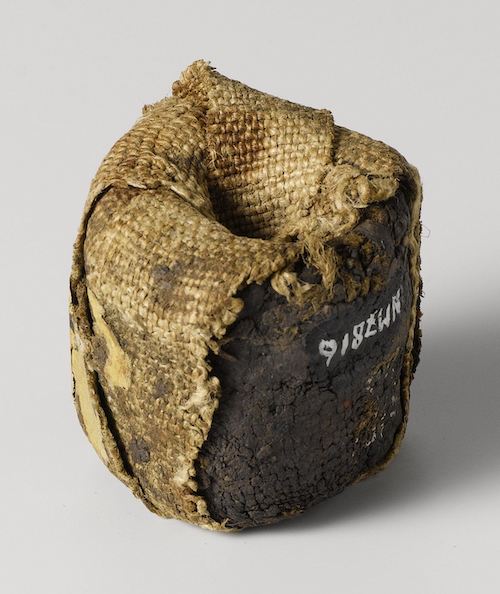
Definition
A durable plain cloth of varying fibers and weights, used for making sails but also for clothing, hammocks, and other uses. Both European and Asian sail cloth circulated throughout the VOC network, but it is notably rare in the WIC record.
Name variants
Related textiles
Context
Early modern sail cloth was made in a variety of types, weights, sizes, and fibers, varying for different types of sails, and standards were just being established by the European navies. European sail cloth in the early modern period was made from hemp, flax (linen), or a hemp/linen blend, but the sail cloth on VOC cargo lists is classified as a cotton textile. The VOC sail cloth is described as wide or narrow; fine or ordinary; or with geographic designations (like Holland, Bengal, Coromandel), which sometimes corresponds to the routes the sail cloth moved, but could also reference a specific type associated with that place. I know of three examples of early modern sail cloth from the Dutch context (one here, and two in the gallery below), and it is as yet not clear what fiber these are woven in and where they originate, nor is their provenance clear, so this is inconclusive.
Most textiles in the dataset are accounted for in pieces, and the per-unit price breakdown for 1710–1715 relatively consistently provides us with a price per piece of sail cloth of around 2.5 guilders, and piece size ranges from 7.45–12.24 x 1.36 meters. [1] However, sail cloth also consistently is traded by rolls of multiple pieces, which vary in price and have multiple modifiers. The most expensive sail cloth is described as Holland, and there is a tentative correspondence in price between Holland sail cloth and Bengal wide or Bengal fine, suggesting these may be equivalent in quality, but they could be different sizes, qualities, and fibers.
It is likely useful to distinguish between European-made sail cloth and Asian-made sail cloth, as there seems to be a difference in price, since the Asian sail cloth may be of cotton fiber, and because more is known of European sail cloth, which contradicts our data. In this dataset, the sail cloth described as Holland travels only from Europe to Asia, and within Asia; while that with Indian/Bengal descriptors circulates in Asia and travels to Europe. Considering the emerging European standards for sail cloth, I’m curious how the Indian/Bengal sail cloth circulated in Europe—whether it became ‘Holland’ sail cloth once imported, and whether it could be differentiated by fiber type or other qualities.
If a geographical distinction is made for pieces, they are Bengal or Coromandel sail cloth; while the rolls are described as Holland or Bengal. This suggests something about the different ways these different cloths were packaged or accounted for. All of this sail cloth was produced in bulk—up to 8000 pieces might be in a single shipment—however, the Coromandel Coast sail cloth is always under 2000 pieces, and generally in the low 100s, suggesting that the east coast of the Indian subcontinent was a smaller or emerging manufactory of sail cloth in comparison to Bengal. K.N. Chaudhuri’s textile glossary, one of very few to include sail cloth, indicates south India as the source, but in this dataset Bengal sail cloth outnumbers Coromandel Coast sail cloth by a factor of five. [2] Is this a case of English circulation differing from Dutch circulation?
Sail cloth was most obviously used to make sails, whose manufacture required specific sizes and qualities depending on the type and use of the sail. [3] Sails, of course, were integral to the functioning of the maritime transport network, and a number of sails belonged to each vessel (these would NOT appear in the cargo lists, as they, instead, belonged with the ship inventory). Sail cloth traded with VOC outposts could be used to replace or repair worn sails, but it also had other uses where a heavy, durable canvas could serve. For example, used sails were reworked into sailors’ hammocks, and tarred sail cloth was used for burial at sea. [4] Sail cloth also made durable clothing: in her discussion of premade clothing provided to enslaved people in the Cape Colony in the eighteenth century, Miki Suguira describes instances of cotton sail cloth, both Holland and Bengal types, used to make breeches and as lining for doublets for enslaved males. [5] She notes that while sail cloth was adequately cheap for this use, it was not comfortable, and would have been supplemented with other textiles. [6]
MK (March 2023)
Notes
- [1]
R. Laarhoven, “The Power of Cloth: The Textile Trade of the Dutch East India Company (VOC) 1600–1780” (PhD diss., Australian National University, Canberra, 1994), appendix A, 54.
Back to text - [2]
K.N. Chaudhuri. The Trading World of Asia and the East India Company, 1660–1760 (Cambridge University Press, 1978), 503.
Back to text - [3]
Thank you to Nathaniel Howe for discussing early modern sail cloth with me in 2021–22.
Back to text - [4]
I’m grateful to John Kuhn for sharing his research on hammocks with me, including this reference to sail cloth put to this use in the National Archives at Kew, Navy Board: Records, ADM 106/272/165. Sail cloth used as a shroud is described under presenning in Instituut voor Nederlandse Geschiedenis, VOC-Glossarium. Verklaringen van termen, verzameld uit de Rijks geschiedkundige publicatiën die betrekking hebben op the Verenigde Oost-Indische Compagnie (The Hague: Institute voor Nederlandse Geschiedenis, 2000), 93.
Back to text - [5]
Miki Sugiura, “The Economies of Slave Clothing in the Eighteenth-Century Dutch Cape Colony,” in Dressing Global Bodies: The Political Power of Dress in World History , ed. Beverly Lemire and Giorgio Riello (London: Routledge, 2019), 115 (doublet lining) and 117 (breeches).
Back to text - [6]
Sugiura, “Economies of Slave Clothing,” 121. Note that the Hollands sailcloth in this table appears cheaper than the Bengal sailcloth, however the Bengal unit is unclear so the per-unit price may not be comparable.
Back to text
Visual evidence
Small roll of tarred sail cloth
This small piece of sail cloth is tarred and rolled in on itself, its purpose unclear.
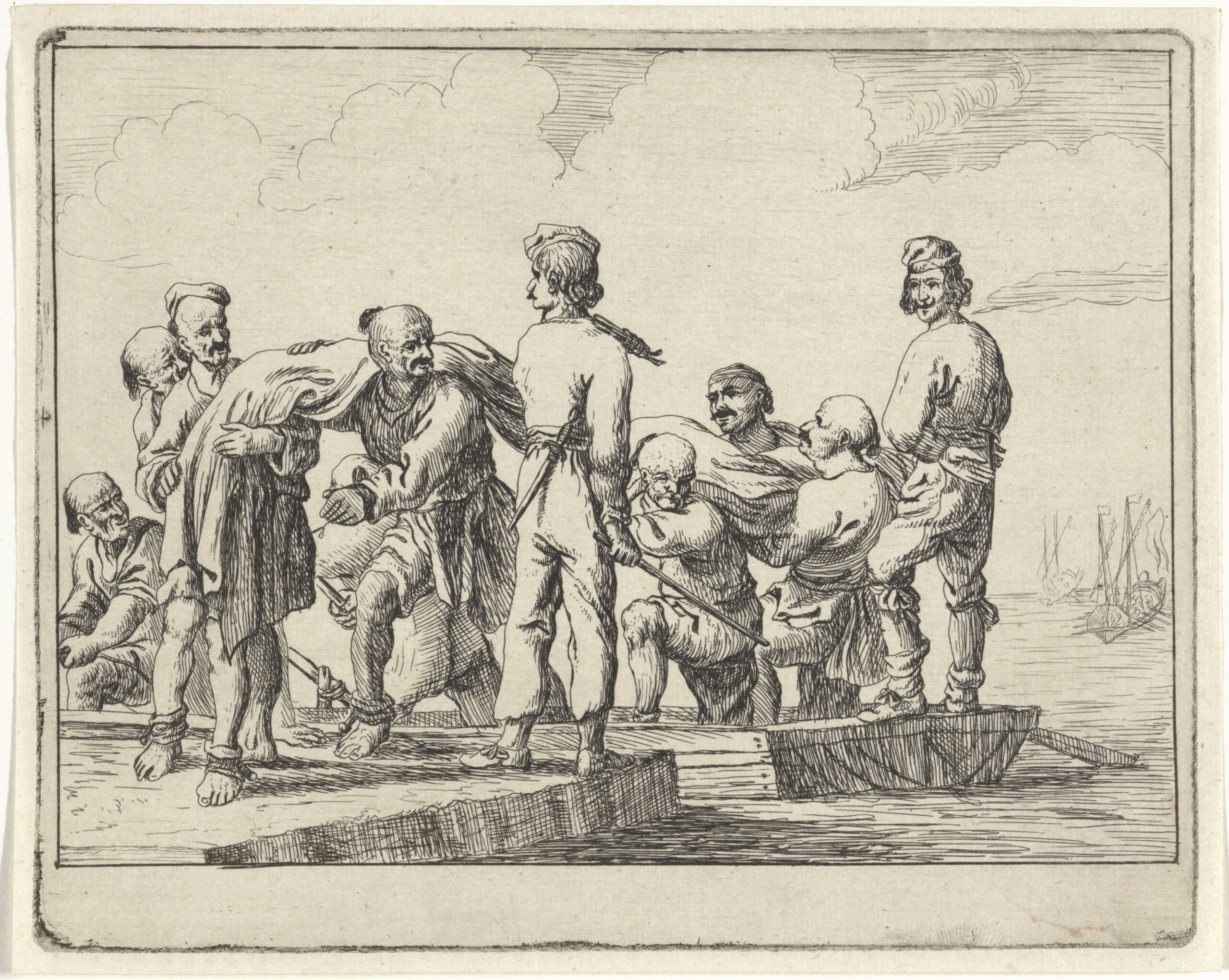
Muslim galley slaves carrying a sail
Five men carry a rolled sail on their shoulders, presumably from one of the ships in the background at right, to shore. Is the sail being moved to shore for repairs, or is this a damaged or old sail that will be put to new use? The galley slaves, whose status is indicated by ankle shackles, have a uniform appearance with similar moustaches and shaved heads. Their clothing is also similar in appearance, long-sleeved tunics hanging loose over short breeches, which could also be made from sail cloth.
Related works 5
Muslim galley slaves carrying a sail
1649Small roll of tarred sail cloth
ca. 1590–1596View of the deck of an Oost-Indiëvaarder with sailor at the helm
1779–1787Fragment of sail cloth
1740–1749Fragment of sail cloth
1740–1749Quantitative record
Textiles, Modifiers, and Values
993 trade records
Explore specific textiles in greater detail, like the quantities, total values, or per-piece values of imported or exported textiles over time or across geographies.
Top destinations