Streep
Explore records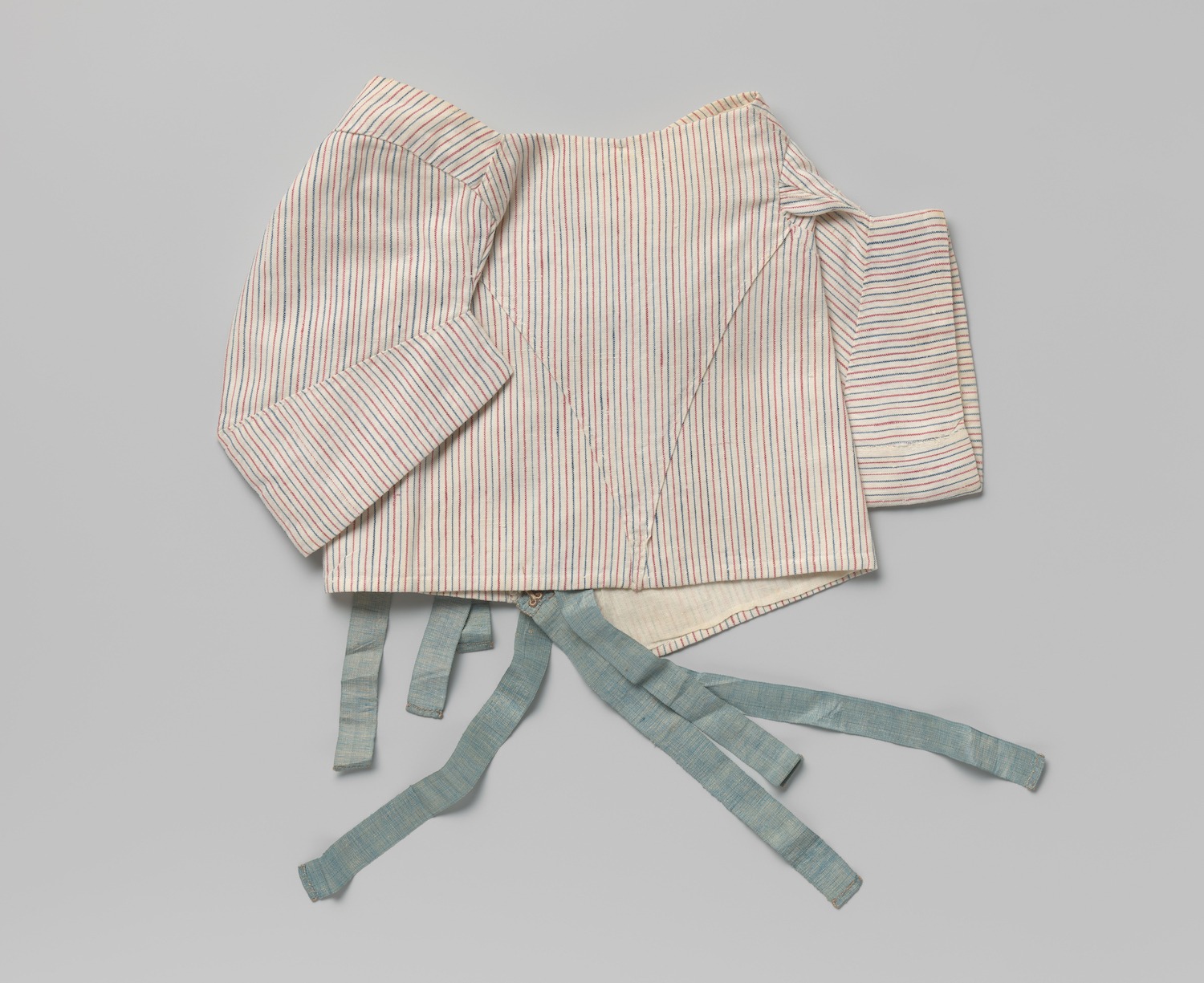
Definition
Refers to a European-made, striped cloth that was probably made of linen. It is often associated with Haarlem, and circulated throughout the Dutch Republic and its colonial outposts in West Africa and the Americas during the eighteenth century.
Related textiles
Context
The fiber used to manufacture streep is never explicitly identified in WIC and MCC invoices. However, shipping records often describe streep as “ Haarlem striepen ” or “ Haarlems gestreept, ” which suggests the cloth was made of linen. Haarlem was the primary center for linen production in the Dutch Republic during the period, and other textiles that employ “Haarlem” as a modifier are known to be made of woven linen. [2] The inclusion of Haarlem as a descriptive modifier may have been intended to distinguish this form of striped textile and its fibers (probably flax) from striped cotton cloths that were also exported to West Africa and the Americas from South Asia, such as guinea cloth . That streep was probably a type of linen is further supported by WIC and MCC invoices that identify women as suppliers of this textile. By the eighteenth century, Dutch women played an active role in the global linen trade, helping to fulfill the demand for textiles like slaaplakens (or bed sheets) that were used to facilitate commercial relations with West African traders. [3] Female suppliers included Elijsabeth Verstraten, who provided 135 els of “haarlems gestreept” and 136 els of “Haarlemse streep” to WIC ships bound for Essequibo in 1707 and 1711, and Louisa Zirk Zee, who contributed 2431 els of “Haarlemer striepen” for a MCC voyage to the Americas in 1726. [4]
Though streep likely originated in Haarlem, it was frequently exported to Western Africa (including Angola), the Americas (Rio Essequibo in Guiana) and the Spanish West Indies (the Caribbean) by WIC and MCC ships. Streep could be shipped by the piece or by yardage and was relatively cheap. Data indicates that the cloth could range in price from 7.5 stuivers–25 guilders per piece or 4.1–6.9 stuivers per el on WIC and MCC shipments respectively from the first three decades of the eighteenth century. [5] While archival entries typically combine streep with “Haarlem,” less expensive streep (4.5 stuivers per el and below) is instead modified by the term “Erberveltse,” the meaning of which remains unclear.
While WIC records do not specify color, MCC entries suggest streep was available in a variety of colors (white, blue, and red) that may have appealed to foreign consumers, on which more will be said below. It is unclear if specified colors refer to the cloth’s base color or to its stripes. White was the most popular color, with approximately 11,915 els of “ witte Haarlemm striepen ” being shipped to the coast of the Americas and the Spanish West Indies on the MCC ship Beurs van Middelburg between 1731–1734 (out of a total of 35,406 els). [6] By comparison, 4,282 els of blue and 4,285 els of red streep were transported by this ship during the same period. [7]
Like WIC and MCC archival records, early modern Dutch sources are relatively silent on the exact fiber employed in the production of Haarlem striepen. For instance, the 1773 volume of the painter and physician Johannes le Francq van Berkhey’s Natural History of the Netherlands (Natuurlijke Historie van Holland ) describes streep as a type of decorative red or blue stripe (“Haarlemmer rood of blaauw Streep”) present on the aprons of West Frisian farmers. [8] Perhaps these aprons resembled an example of a girl’s red-and-white striped skirt (c. 1700–1799) held in the Fries Museum. Van Berkhey’s later commentary on “kraamfeesten” or maternity celebrations held after giving birth also notes the cloth’s use in children’s clothing: “with the end of all these maternity festivities, the time approaches to dress the child; that happens sooner or later, depending on whether the child is prosperous and the season is favorable, usually about the eighth or at the latest the twelfth week…White fine linen or muslin is the common style. The country-men often take chintz, cotton, or Haarlemmer Streep.” [9] Van Berkhey’s account distinguishes streep as a type of cloth separate from cotton, further underlining the likelihood that it was a form of linen. Yet he does not provide further insight into the cloth’s appearance. It is possible that streep may have appeared similar to the interior linen linings that were used for silk, cotton, or woolen clothing in the eighteenth century. Surviving examples of a women’s chintz jacket ( jak ) with floral patterns (c.1775–1779), shown above, and a brown woolen jacket with split-vest panels (c. 1750–1774) in the Fries Museum are lined with striped linen fabric.
As an export to the coast of West Africa and the Americas, Haarlemmer streepen—especially those versions with red or blue stripes—must have been intended to appeal to local consumers. Colleen Kriger and others have addressed the popularity of red and blue striped cloth, such as gingham , bajutapauts, nickanees and guinea cloth on the Gold Coast and in the Bight of Benin. Such European- and East-Asian produced textiles adhered to pre-existing tastes and cultural values in these regions, and were worn by both West African elites and enslaved peoples in the Americas. [10] For instance, Albert Eckhout’s paintings of a West African Man (c. 1641) and Angolan Woman and Child (c. 1641)—who have been interpreted as an elite trader from the Gold Coast and an enslaved woman from Angola—wear blue-and-white striped cloths around their waists. [11] Haarlem streep may have been meant to compete with imported striped cotton cloths, or locally produced blue-and-white strip cloths that were sometimes incorporated into the clothing of West African nobility. [12] For example, a blue-and-white tunic composed of cloth sewn together in vertical strips, which became a part of the German merchant Christoph Weickmann’s (1617–81) collection in the mid-seventeenth century, was likely originally worn by a ruler or elite nobleman in the Kingdom of Allada. [13] Perhaps the stripes on Haarlem Streep were of a different width than those present on other examples of striped cloth in West Africa.
Hannah Prescott (November 2024)
Notes
- [1]
Alpern defines lhymenias (“lemenias”) as a fine, striped cloth, although definitions for this type of textile do not agree on pattern. See Stanley B. Alpern, “What Africans Got for Their Slaves: A Master List of European Trade Goods,” History in Africa Vol. 22 (1995): 7. For an example of “gestreept linnen” (lijnwaad) see WIC_1.05.01.02_1303_300-303; for boekjes, see WIC_1.05.01.02_1304_196-199.
Back to text - [2]
G.T. van Ysselsteyn, Van Linnen en Linnenkasten (Amsterdam: P.N. van Kampen & Zoon N.V., 1946), 44–48; John Horner, The Linnen Trade of Europe during the Spinning-Wheel Period (Belfast: M’Caw, Stevenson & Orr, Ltd., 1920), 352–356; Linda Stone Ferrier, Images of Textiles: The Weave of Seventeenth-Century Dutch Art and Society (Ann Arbor: UMI Research Press, 1985), 57–58. For other linen textiles linked to Haarlem, see, for example “Haarlemmer Boeklinnens,” or “boekjes” which have been described as “ordinary, plainly woven linen” that is “usually blue and white striped or checked.” See Nederlandsch handelsmagazijn Vol. I (Amsterdam: Diederichs, 1843), 762 a.
Back to text - [3]
For more on women’s involvement in the linen trade, see Carrie Anderson, “From Bedsheets to Bandages: Lost Linens of the Early Modern Dutch Atlantic World,” in Nonextant Art and the Early Modern World, eds. Dana E. Katz and Dawn Odell (volume in progress); Danielle van den Heuvel, Women and Entrepreneurship: Female traders in the Northern Netherlands, c. 1580–1815 (Amsterdam: Askant, 2007), 203–24.
Back to text - [4]
On Elijsabeth Verstraten, see WIC_1.05.01.02_1289_319-321; WIC_1.05.01.02_1292_96-99. Louisa Zirk Zee is listed as a supplier for several MCC voyages between 1723–28, providing varied types of linen (including lijnwaad, boekjes and streep), as well as armosynen (a cheap, coarse silk cloth), silk stockings, and beddetijken (bedding or mattress ticking) for the Atlantic trade. For her supply of Haarlemer striepen see MCC_233.6_1-9.
Back to text - [5]
The current data set incorporates invoices from VOC, WIC and MCC ships, and runs from 1699–1780. For a 1709 shipment on the ship Adrichem (7.5 stuivers per piece), see WIC_1.05.01.02_1290_231-232; for a 1712 shipment on the Prins van Orange (25 guilders per piece), see WIC_1.05.01.02_1293_229-233. For a 1733 shipment on the MCC Beurs van Middelburg (4.1 stuivers per el.) see MCC 233.6; for a 1723 facturen from the same ship (6.9 stuivers per el.) see MCC 233.6.
Back to text - [6]
See MCC_233.6_48, 64, 91.
Back to text - [7]
See MCC_233.6_48, 64, 91. Most archival entries do not list a particular color. It is possible that streep came in an assumed color, from which anything else was a departure.
Back to text - [8]
“Dog om nader ter zaake te keeren, deeze Boezelaars, die men in Noord-holland ook veelal van eene zekere soort van zoogenaamd bruin Vriesch Boezel maakt, behooren tot de algemeene dagelyksche dragt der West-Vriesche Land- en Visschers Vrouwen. Deezen hebben gemeenlyk haare grove Boezels, om mede te roezeboezen; maar buiten die ook Schortelkleeden, van eene fyner of beter Boezelstof; welken zy van boven met een Rand, of, in haare Taal, een endje, Haarlemmer rood of blaauw Streep , versieren; waar toe de deftigsten en zindelyksten ook wel gebloemd Katoen gebruiken.” See J. Le Francq van Berkhey, Natuurlijke Historie van Holland, Vol. 3 (Amsterdam, 1773) 993.
Back to text - [9]
“Met het afloopen van alle deeze Kraamfeesten, nadert de tijd, om het Kind in de kleeren te steeken; dat vroeger of later geschied, naar dat het Kind voorspoedig, en het Saisoen gunstig zijn: doorgaans omtrent de agtste, of uiterlyk de taalfde week…Wit fijn linnen of neteldoek is de gemeene trant. De buitenlieden neemen veeltijds chits, katoen, or Haarlemmer streep.” See van Berkhey, Naaturlijke Historie, Vol. 3, 1266.
Back to text - [10]
Colleen Kriger, Cloth in West African History (Lanham: AltaMira, 2006), 38–39, 135–139; Cécile Fromont, “Common Threads: Cloth, Colour, and the Slave Trade in Early Modern Kongo and Angola,” Art History Vol. 4, No. 5 (2018): 857–858, 864. See also Carrie Anderson’s entries on nickanees and guinea cloth in the Dutch Textile Trade Visual Glossary.
Back to text - [11]
Rebecca Parker Brienen, Visions of Savage Paradise: Albert Eckhout, Court Painter in Colonial Dutch Brazil (Amsterdam: Amsterdam University Press, 2006), 153. Unlike the striped cloth worn by Eckhout’s West African Man and Angolan Woman, blue-and-white cloth is incorporated as a strip into the regalia worn by an Ambassador from the Kingdom of Kongo to Johan Maurits’s court in Recife, who is represented in one of Eckhout’s oil on paper portraits in the Jagiellonian Library in Krakow. See Eckhout, Portrait of a Kongo Ambassador to Recife, c. 1637–1644, Libri Picturati A. 34, fol. 3, Jagiellonian Library, Krakow; Fromont, The Art of Conversion: Christian Visual Culture in the Kingdom of Kongo (Chapel Hill: University of North Carolina Press, 2014), 117.
Back to text - [12]
On the tradition of blue and white strip cloth, see Kriger, Cloth in West African History, 137–138.
Back to text - [13]
The Weickmann Collection’s 1655 catalogue identifies two blue and white tunics: “A gown or garment such as the kings at Haarder are accustomed to wear, with very large and wide sleeves.” And “A knight’s gown or cassock, such as the King of Haarder (Allada) in Africa is accustomed to present when he makes someone a nobleman or knight. In form and shape it is like the royal gown, but it is of different material and colors.” Quoted in Adam Jones, “A Collection of African Art in Seventeenth-Century Germany: Christoph Weickmann’s ‘Kunst- und Naturkammer,” African Arts Vol. 27, No. 2 (1994): 35.
Back to text
Visual evidence
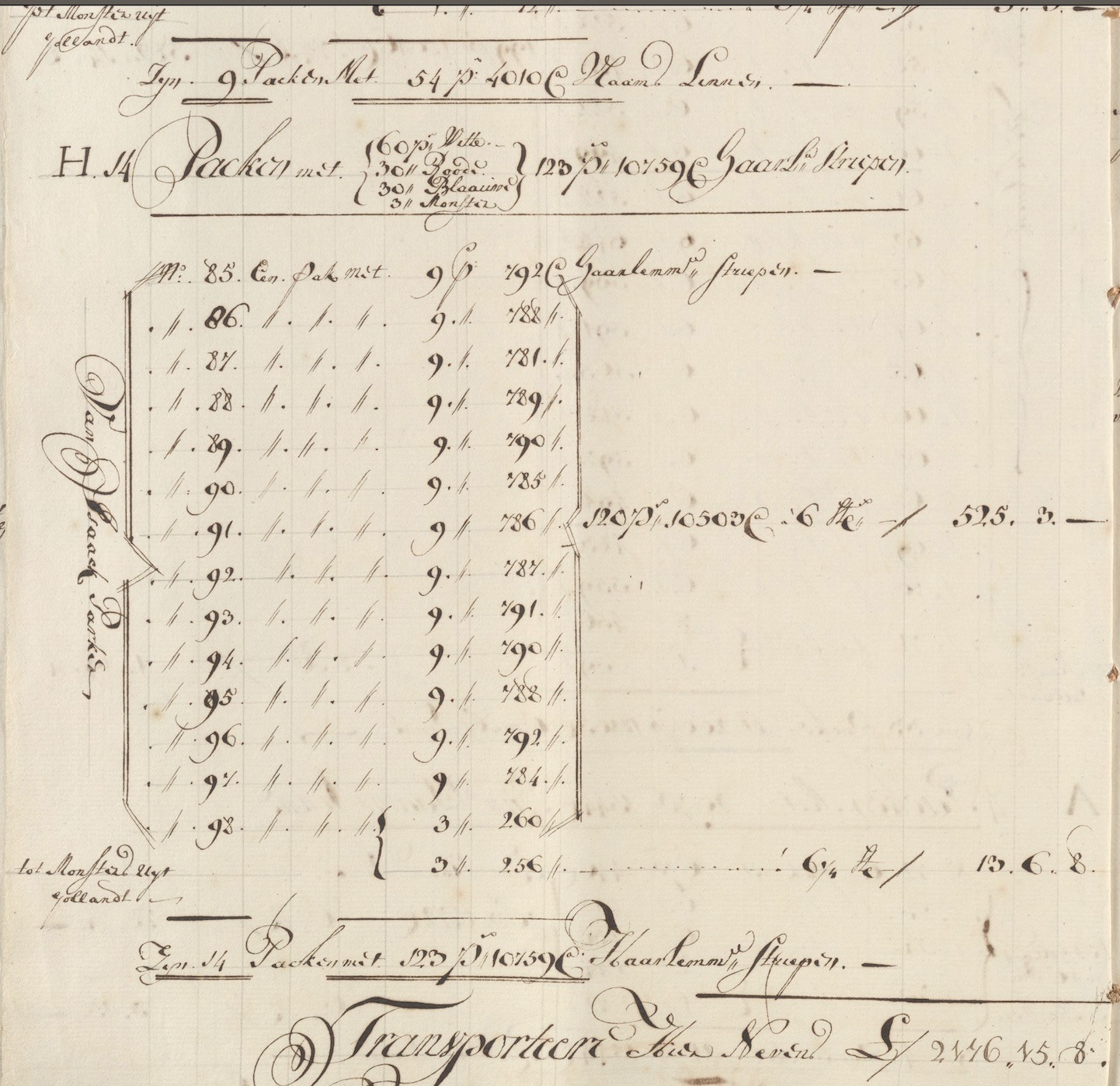
Invoice with Haarlem Streepen
This page from the 1731 invoice of the MCC ship Beurs van Middelburg—destined for the Spanish West Indies—lists several possible colors for Haarlem streepen. Of the 123 pieces supplied in this pack, 123 pieces were white, 30 pieces were red, and 30 pieces were blue
A Child’s Coat Made of Striped Linen
This child’s linen jacket is made of blue and red striped linen on a white ground
Related works 6
Linen Lining with Blue Stripes
c. 17th–18th centuryA Woman’s jacket made of dark brown wool with split vest panels and lined with brown-and-white striped linen
c. 1750–1774A Girl’s Apron with Red and White Stripes
c. 1700–1750Invoice with Haarlem Streepen
1731A Child’s Coat Made of Striped Linen
c. 1700–1750A Woman’s Chintz Jacket with Striped Linen Lining
c. 1775–1779Quantitative record
Textiles, Modifiers, and Values
12 trade records
Explore specific textiles in greater detail, like the quantities, total values, or per-piece values of imported or exported textiles over time or across geographies.
Top destinations